To those of you who are unfamiliar with the Old 97’s:

My friend John introduced me to the Old 97’s several years ago during a summer we all dubbed “The Summer of Rock Music,” although really our traipsing around to every show we possibly could lasted well into the fall and possibly winter of that year and into the following year.

The Old 97’s are one of those bands that I will always regret not having in my life sooner. There’s other bands and singers I could have written about here with whom I have been acquainted with for much longer, have been a part of my formative years, been with me through several physical and metaphorical journeys and blah blah blah, but sometimes a band just hits you at the right place at the right moment and effortlessly inserts itself into the soundtrack of your life. And that’s what the Old 97’s did for me. The truth is my years in San Antonio are some of the best years of my life, and the Old 97’s will always transport me back to hot summer nights in dusty dance halls, drinking Shiner and rocking out to some amazing live music. They provided the background music to my life in Texas.

I hadn’t heard very much of their stuff before I went to that first show in 2011. John made me a CD he titled “The Old 97’s Crash Course,” and that was my introduction. I was instantly hooked, listening to it nonstop leading up to the show. And I fell in love from the first chord they struck onstage. They will always be one of the best live shows I’ll ever see, no matter how many more shows I live to see.

I have no idea in what genre to classify them, and I think that’s one of the best things about them. Some of the songs sound country, some sound a little punk, some a weird mix of the two that somehow always works. And their catalogue of work is so prolific, they’ve spilled over into several other genres at this point. But lead singer Rhett Miller just calls it all rock and roll like he doesn’t really give a shit what box they fit into or if they fit into any box at all. And that’s pretty cool.

I saw them several times in San Antonio before I left the state for good – saw all the things you come to expect at a good Old 97’s show: at least one proposal during “Question,” bassist Murry Hammond singing a smattering of crowd favorites, Rhett drunkenly backing up Murry on “Valentine,” the time-honored and never-failing “Timebomb” at the end of the show (after what is usually a lengthy encore), and I’d be remiss if I didn’t mention Rhett’s hair that just keeps getting more amazing every time I see them (seriously, what is that?).

It was everything I could ever want in a band – raw and gritty, a little jaded with just enough cynicism to make it feel real, not forced or contrived or trying to be anything it’s not. Give me a band who claims “Let’s Get Drunk and Get It On” as one of their few love songs and belts out the lyric “Love is a marathon – sometimes you puke,” and I’m instantly sold. Screw all that impossible love crap. I want real, and that’s what you get with a good Old 97’s song.

The real reason I was struck with inspiration to write this love letter is that recently, after not having the opportunity to see the Old 97’s since I left Texas more than four years ago, they finally came to my neck of the woods here in Virginia a couple weeks ago. San Antonio was the last time I had the chance to be around great music, to discover new bands and go see some amazing performances. I’ve been missing and trying to get back to it ever since.

So when I saw the Old 97’s were performing in Norfolk at one of my favorite venues, there was no way I was missing it. I went by myself, because screw it, right? A friend had to bail unexpectedly, and there wasn’t anyone else I wanted to take who I thought would appreciate them the way I did, and anyone who loves music like I do knows you don’t take just anyone to see one of your favorite bands. Besides, the Old 97’s feel like old friends. We’ve got history that now crosses state lines.

From the moment they stepped onstage that night, I was transported back in time those hot summer shows in San Antonio. It was a different vibe seeing them outside their home state in a way I can’t explain except to say that they understand Texans in a way they’ll never understand Virginians, but it didn’t make it any less amazing. And it reaffirmed everything I love about their music – the energy, the in-your-face lyrics, the big ole middle finger to the man, and a subtle ode to the working man (or woman) in all of us that always feels a little Dylan-esque to me.

My only disappointment was that they couldn’t play forever. There’s no greater feeling than going to a show and never wanting the band to stop playing. It made me homesick in a way I hadn’t really fathomed I missed Texas, so maybe this is a love letter as much to Texas as it is to the Old 97’s.

So come back soon, boys. This homesick pseudo-Texan will be waiting in the front row, hoping you play a little “State of Texas” to help me miss it just a little less for a while.

Love,
Kellie

RECOMMENDED LISTENING

Valentine

Won’t Be Home

A State of Texas
Dear Carlos,

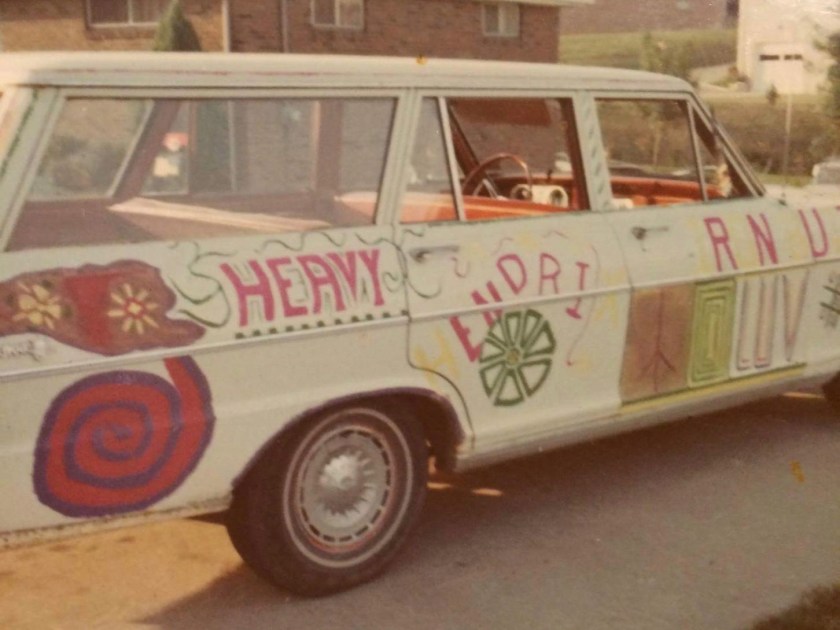
In 1969, I passed up an opportunity to attend a music festival in New York State. It seemed too far to travel in an old beat up station wagon to see bands perform in the hot summer weather.

IMG_1193 (1).jpg
Aforementioned station wagon

Later that fall, my friends and I travelled to downtown Pittsburgh via public bus, as we did often, to hang out and visit some of our favorite stores which included National Record Mart. We loved sifting through the newest albums by artists we heard on what was considered “underground” radio on an increasingly popular FM station.

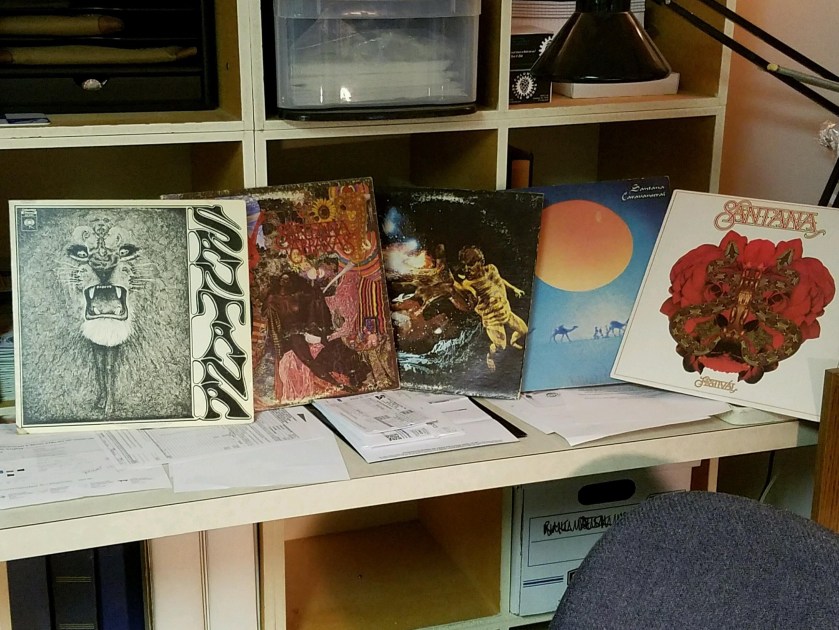
That day at the Record Mart, my friend Michael and I debated about whether or not to purchase an album recorded by a new band that performed at the little concert I missed in August. I heard their pulsating Latin rock song “Jingo” on the radio, and hoped there might be more of the same on the LP. The artwork on the cover lured me in as well. Neither of us had enough money to buy the album so we split the cost and bought it together.

Back in our neighborhood, we all went to a friend’s house to listen to our new purchases. First up was side one of our choice pick, Santana’s debut album. Frankly, I was blown away! I couldn’t believe the shear energy and pulsating beats that seemed to match my own high energy personality. After we finished side one, Michael turned to me, stated that he hated it, didn’t want to listen to side two, and I could have it.

Well, I still own that album Carlos. It’s not in very good shape anymore since I literally wore it out playing it over and over again in my black lit bedroom, replete with glowing posters and burning incense.

I listened to plenty of rock n roll back then. My mother exposed me to ‘50s rock n roll in the early ‘60s, on nights my father wasn’t home. Then there was the British invasion lead by my beloved Beatles. But this was different. Your sweet guitar playing had me mesmerized—my mind absorbed the notes you so elegantly and precisely played—while the percussion kept my heartbeat at a rate that intoxicated my body.

I found music that touched me in a way no other had. At a time when my home life was filled with strife and misery, I stumbled on an artist that could help me endure and keep my head straight when I needed an interlude from my surrounding life. Following that first album came four more that I bought, listened to and wore out as I had the first.

IMG_1083.jpg
My well-worn collection of Santana LPs

After that, my life became busier and more complicated as I graduated college, began a career, married and started a family. Some of the albums became eight track tapes played in a device mounted under the seat of my Volkswagen Beetle and, after that, cassettes in my van. Of all the music I listened to, it was your albums that I first purchased in the latest technology so I could listen to them as best as they could sound. They accompanied me from one state to another via car or plane so I could listen to them whenever I needed a mental boost or simply wanted to hear some comfort music. I have listened to all of your other albums, including the more recent collaborations, and enjoy them as well.

Over the years I’ve listened to plenty of other music, and tend to judge albums by how many of their songs I truly enjoy. There have been a scant few that I enjoy 100%, and your earlier albums make the list. After all these years I still listen to them, now on an iPod. In fact, today I listened to Abraxis while taking a jog.

By the way, I have only had the pleasure of witnessing you perform live once. I brought my wife to see you at the Civic Arena in Pittsburgh. At the time, she listened to the Eagles, James Taylor, Van Morrison and similar artists, but went with me anyway (I think) just to keep me company. Before you began, I explained to her that if she wanted to better understand my infatuation with your music, to try to focus on your guitar playing while the rest of the music fills in as background. Guest what? Two songs into it, she looked at me and the only thing she said was “Wow!”

Carlos Santana, your music has helped me through the harder times of my life and inspired me during the most wonderful times of my life. Thank you for being there for me.

Bill

Dear Leon & Karen,

Preface

As all “good” music obsessives know, there are many, many factors that cause a song to really resonate with a listener. If we can momentarily suspend the fact that any given song will or will not appeal to any given listener based off of a myriad of human factors which are too amorphous and varied to even attempt to quantify such as; life experiences, quality of hearing, interest in particular topics or themes, recording quality preferences, size of ear holes, etc. etc. etc. then for the sake of this letter please just allow me to focus on two factors, the song writing and the recording.

This letter is addressed to the song writer (Leon Russell) and the performer (Karen Carpenter) of one version of “A Song For You.”

The Carpenters: A Song For You

Those of us who voraciously devour music know that sometimes amazing songs are written but that often recordings and/or artists are fallible which results in the recorded version of a song somehow just missing the mark. Conversely, sometimes the actual song writing quality is questionable but with cool production tricks it suddenly morphs into something really great (think songs being played on Top 40 radio at any given moment in any given decade). “A Song For You” as covered by The Carpenters is, in my opinion, a grand slam, because the recording/performance is so beautiful (dare I say perfect?) and the songwriting is so strong. With no further musical nerdiness, here is my letter to Karen and Leon.

Leon,

I am so embarrassed. I didn’t know who you were until I listened to “A Song for You” and then read the liner notes. I’m so ashamed because as someone who has been obsessed with music since childhood, and particularly older, less modern, music it seems that I most certainly should have known about you. Oh! But! Leon! I bet you already know this, but this is one of the joys of being obsessed with music. You can constantly discover new artists, who actually aren’t new at all.

leonrussellstudio.jpg
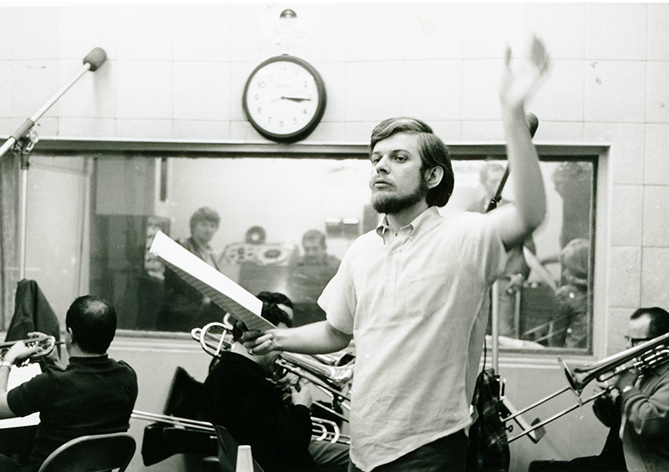
Leon Russell in the studio

So, now I know who you are, and you can’t escape me. I have yet to delve into your recordings or discography because The Carpenter’s cover of your song “A Song for You” has been more than enough as of right now.

When I talk about music with people who really like to talk about music I have certain preferred topics that I believe never get old. One of these topics is the concept that if a person writes one good song in their lifetime that this might be enough. Maybe not enough for them personally as an artist, but enough in terms of contribution to the world. I’m sorry to even have to write this next line Leon, because clearly you already get this, but there are other people who will be reading this letter so forgive me. MUSIC IS POWER. One song, one recording can have so much impact. I truly believe this. And again, I know I’m preaching to the choir here, but once a song is recorded and distributed there is no limit to what it can do. In some way, songs are like viruses, they could lie dormant and undiscovered for years, but once they are revealed there is no controlling the impact they might have.

We are so lucky to live during the age of recorded sound Leon! Do you agree?

Ok, I need to focus here. I don’t want to waste too many words on the glories of recorded sound (save that for another letter). I want to acknowledge to you that I am blown away when I think about the art of being a song writer. I like to imagine song writers as conduits for THAT SOMETHING that is transcendent and bigger than all of us puny humans. When it comes to serving as a dowsing rod for that unspoken/unseen magic in the world, you’re a darn good one Leon!

I feel both envious of and sorry for the person you were focusing on when you wrote “A Song for You.” The lyrics are so honest, a real heart snatcher. If I imagine I’m the focus of the song I don’t know if I can even tolerate listening to it. Too many feelings! You manage to capture a combination of self-deprecation, nostalgia, regret, indebtedness, love, an acknowledgement that life is time limited, and the experience of being in the moment/connected to someone else in less than 200 words. How Leon?!?!?!? This is magic Leon!!!!

I’m going to reign in my wonderment for the sake of sanity and trying to be succinct.

You did it Leon. Per my perception, you wrote a song that would win a gold medal if writing songs was an Olympic sport. I don’t know how, I don’t know why, but you cracked the door between the mundane human world and transcendence.

I’m in awe, and I thank you.

Karen,

I’ve been interested in you as a person and have enjoyed your music since the age of 10. You see, in 1989 they released a made-for-TV movie about you called The Karen Carpenter Story and I watched it with my family.

I don’t remember full details of the plot, but I do remember the feelings I experienced during and after the movie. Per the events depicted in this film (and perpetuated in popular culture) your story is tragic. Here is someone young, talented, and driven who has one of the world’s best singing voices and yet she cannot accept herself. This lack of acceptance manifests as an eating disorder which eventually kills you. Sad, sad, heartbreakingly flawed human stuff here. We want you to be as perfect as your voice. Maybe you wanted to be as perfect as your voice too? Did you even know how good you were? But, you’re a human and therefore you can’t be perfect and therefore you’ve got a level of darkness that eventually takes that voice away. There are certain moments in the lives of those of us who ravenously consume music, movies, art, and other pop culture that are light bulb moments. Seeing your story was one of these for me. At 10 I began to realize that you could be supremely gifted and successful but that didn’t mean what people saw on the outside matched what was going on the inside. I was shocked. You, and your story, broke my heart even though you had already been dead for 6 years when I first learned about you.

sb-carpenter.jpg
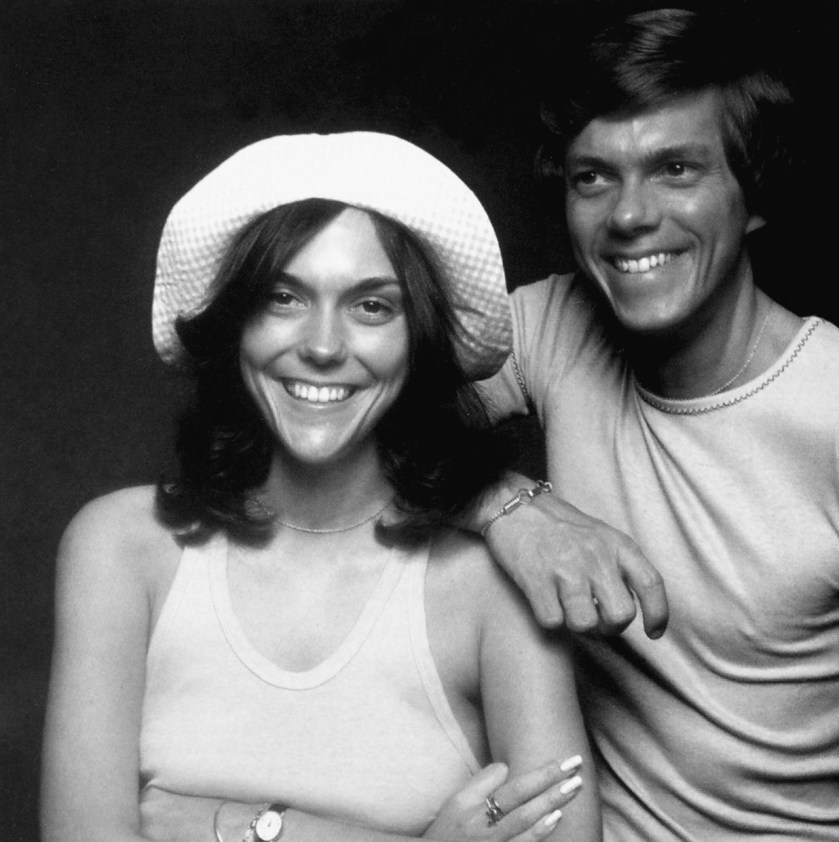
Karen Carpenter and Richard Carpenter

Well Karen, your capacity for heartbreak is, ironically, still alive and kicking some 27 years later. This summer I bought your album “A Song for You” on LP for 50 cents at a used media sale. Side one, track one is the title track and oh, it’s a killer! I almost hesitate to say this out loud, for fear that it sounds melodramatic, but I want to be honest with you Karen. You deserve honesty. When I heard this song it was a good thing that I was laying down on my couch because otherwise I feel like I might have fallen down. There are so many things that make it good. The production, the studio musicians playing on the track, the song progression, the lyrics, but the best part of course is you, or to be more specific, your voice. Smooth, sad, and in this particular case there is a tone (maybe real, maybe imagined on my part) of presage. There is something about your annunciation on the line, “And when my life is over, remember when we were together,” that is too much to take. The sound is beautiful, the sentiment is nostalgic, but the feeling…goosebumps.

I will tell you that I’m really sad that you’re gone, but that’s also just me being selfish, wanting more of a good thing. I will also tell you that I am so happy that you ever existed. Not only that, but you existed at a time when recording sound was possible. What if you had been around pre-recording technology? Your voice would have been heard by so many less people, if any at all, and that would be a crime. Furthermore, you were recording music post-Les Paul which meant that your brother was able to use the technique of overdubbing to really capture and highlight the beauty of your voice.

Anyway, I’ve been really obsessed with “A Song for You” for the past couple of months. I think it might be one of the best songs ever written/recorded. I cry a little bit every time I hear it. When I’m in the car I listen to it via YouTube, but I have to be careful because it can be dangerous to drive and cry at the same time. I’m trying not to wear it out because it feels so powerful and I’m trying to sustain the experience of feeling those feelings in a controlled way.

Music is so powerful Karen. You were an amazing conduit. One of the best.

APRIL

To the non-believers,

The Monkees should have been inducted into The Rock and Roll Hall of Fame years ago. I don’t care if you think the Hall of Fame is a joke, mismanaged, bloated, a blight on the good name of Cleveland, and/or a glorified Hard Rock Cafe with worse food. I support the idea of rock ‘n’ roll honoring its own, and there is a long list of artists that I think are long overdue for such recognition. To my mind, The Monkees are The Rock and Roll Hall of Fame’s most egregious omission to date.

For years, I’ve said that The Monkees would never be inducted, even though they richly deserve that honor. But I dunno. I’m starting to wonder if it may be possible. I’m starting to believe. And so I imagine what I would say if I were inducting The Monkees into The Rock and Roll Hall of Fame.

I’m a believer.

Doesn’t it feel good to say that? Doesn’t it feel good to acknowledge that giddy feeling of joy that wells up within you when you hear a terrific, transcendent pop song on the radio? Isn’t it great to let the music fill you with that grand, unspoken sensation of freedom, to turn the volume up as loud as you can, and just sing along, even if you don’t really know all the words? Your troubles don’t vanish; your cares won’t slip away; your work still has to be done, your heart still requires mending, and your body and soul still shudder from the unnamed ache that never quite surrenders its grip. But for approximately two minutes and twenty-nine seconds, you are able to transcend much of what’s wrong in the world.

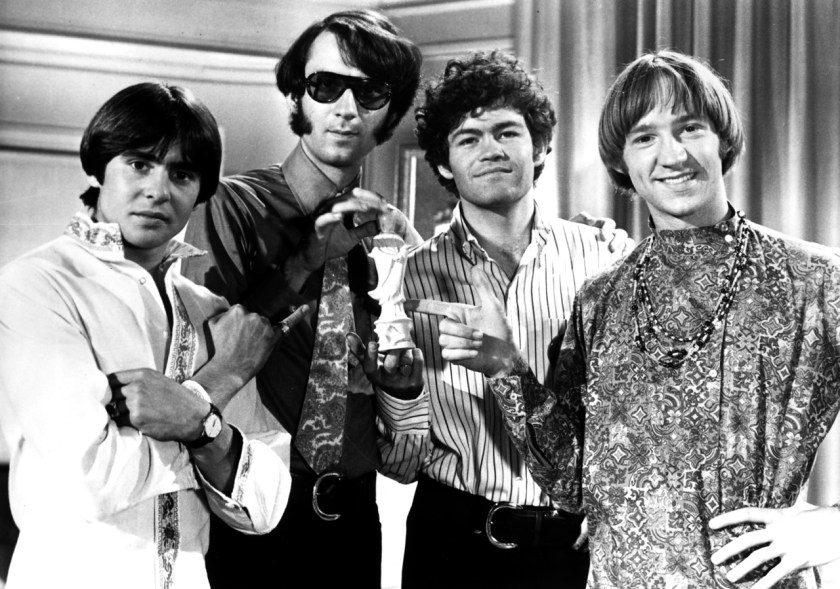
Micky Dolenz, Davy Jones, Peter Tork, and Michael Nesmith. I was six years old when The Monkees debuted on the charts and TV screens in 1966, with a # 1 hit single called “Last Train To Clarksville” and a vibrant weekly NBC-TV show at 7:30pm (6:30pm Central time). I didn’t know they weren’t cool. Because, obviously, they were cool: they were like a magic, irresistible combination of Batman and The Beatles—and really, in the ’60s, what could be cooler than that?

Of course, The Rock and Roll Hall of Fame wasn’t created to validate the tastes of clueless six-year-old suburban kids. That’s fair. The Hall of Fame is a celebration of rock ‘n’ roll music, an embrace of its history and the people who made it happen. It’s a tribute to the power of that music, to rock’s ability to express and embody rebellion, to break down barriers, to inspire, to transcend, to elevate, to unite. It’s about more than catchy pop songs, more than a manufactured image, more than photogenic faces on the cover of a teen magazine. It means something. It matters.

But you wanna know something? It turns out The Monkees somehow did all of that. The Monkees rebelled. The Monkees broke down barriers. The Monkees inspired, transcended, elevated, united. The Monkees mean something. The Monkees matter. This shouldn’t be true—this was supposed to be soundtrack music for a TV sitcom, for God’s sake—but the evidence is there, and it’s been there from the start. The evidence will make a believer out of you, too.

The Monkees’ popularity is indisputable fact: # 1 singles, # 1 albums, the best-selling musical act of 1967, famously outselling The Beatles and The Rolling Stones combined. The Monkees’ recordings have remained radio staples for five decades and show no sign of ever fading away. Reruns of the TV series have continually renewed the group’s fan base, as new generations of fans have discovered the enduring appeal of four guys walking down the street, getting the funniest looks from everyone they meet. The Monkees charted again, with both old and new recordings, in 1986. The Monkees charted yet again in 2016 with a fantastic new album, Good Times!. Their live shows have continued to draw crowds and earn rave reviews. People like The Monkees.

But popularity alone does not make an act worthy of induction into The Rock and Roll Hall of Fame; there are dozens and dozens of mega-selling pop entities that will never be considered Hall of Fame material, and rightly so. But The Monkees were also influential. More than any other act—even more than The Beatles—The Monkees brought the burgeoning ’60s counter-culture into everyday American living rooms, via their weekly TV showcase. They had long hair. They brandished peace symbols.

the-monkees-the-monkees-30313746-1280-899.jpg

Timothy Leary called The Monkees TV series “a classic Sufi put on. An early-Christian electronic satire. A mystic magic show. A jolly Buddha laugh at hypocrisy.” John Lennon called The Monkees “the greatest comic talent since The Marx Brothers,” and said he never missed a show. As lead singer for The Stone Poneys, Hall of Famer Linda Ronstadt had her very first hit with a Michael Nesmith composition, “Different Drum.” Hall of Famers Run-D.M.C. and The Paul Butterfield Blues Band both recorded Nesmith’s “Mary, Mary.” Hall of Famers The Sex Pistols covered “(I’m Not Your) Steppin’ Stone.” Hall of Famer Elvis Costello has praised The Monkees, and Michael Stipe of Hall of Famers R.E.M. has specifically cited The Monkees as a key influence. Bob Dylan, Jerry Garcia, Frank Zappa, and George Harrison have all publicly defended The Monkees against naysayers. That ain’t bad for a group that claimed to be a manufactured image, with no philosophies.

I’m a believer.

Belief sustains us, even when everyone says we’re wrong. Music comforts us, when much of life may seems uncertain and perilous. Love, hope, and friendship encourage us, when our senses and surroundings insist there’s little of substance left to grasp and hold fast. We are saved by our friends, our hope, our love, our music; we are saved by our belief.

The music of The Monkees has been my friend for over fifty years. As a six-year-old kid infatuated with these fun-loving characters on my TV screen; as a preteen learning about comedy (and training for eventual Marx Brothers worship) via Monkees reruns on Saturday mornings; as a teen falling hard, well after the fact, for The Monkees’ music in the ’70s; as a young punk rocker in the ’70s and early ’80s, eager to defend The Monkees on all fronts; as a record store manager in 1986, mentoring the new, young Monkees fans that MTV had brought through our doors; as a pop journalist, who has written more about The Monkees than I’ve written about any other subject; and as an unrepentant, unapologetic fan, I know how much The Monkees have always meant to me. Whatever man I am, whatever person I try to be, watching The Monkees, and listening to The Monkees, is an essential part of me. The delight and wonder that The Monkees’ sunshine factory has brought into my world—into this world, our own world—is beyond measure. With my fools’ gold stacked up all around me, in rows of houses that are all the same, as good times start and end, and we have to do this all over again: we’ll make up our story as we go along. I have no more than I did before, but now I’ve got all that I need.

Micky. Davy. Peter. Michael.

Weren’t they good? They made me happy. I’m a believer. I welcome you as a believer, too. And, at long last, we finally welcome The Monkees to The Rock and Roll Hall of Fame.

Carl

This excerpt is from the music blog Boppin’ (Like The Hip Folks Do) run by Carl Cafarelli, a pop journalist who co-hosts THIS IS ROCK ‘N’ ROLL RADIO with Dana Bonn (Sunday nights, 9 to Midnight Eastern). As a freelance writer, he contributed to Goldmine magazine from 1986–2006, wrote liner notes for Rhino Records’ compilation CD Poptopia! Power Pop Classics Of The ’90s (along with several other albums) and has contributed to numerous books about music. His standing offer to write liner notes for a Bay City Rollers compilation remains criminally ignored. 

RECOMMENDED LISTENING

Porpoise Song (Theme from “Head”)

Early Morning Blues and Greens

Me & Magdalena
(Written for the Monkees by Ben Gibbard of Death Cab for Cutie)

My dearest friend – whom I’ve never met – Conor Oberst,

How are you, old friend? Been a long time since I’ve heard your voice—the distinctive voice that makes me question the true meaning of the word “beautiful.” It’s almost like we need to create a new word to describe your delightfully wonderful and fantastic voice. It’s so shaky, frightened and remarkably unusual that you can’t call it beautiful, yet it truly is. 

Let me remind you, in case you forgot, that the first time I heard your music was back in the Bright Eyes days. On the album Fevers & Mirrors, I believe that “Something Vague” and “The Calendar Hung Itself” captured my attention. “I kissed a girl with a broken jaw that her father gave to her. She had eyes bright enough to burn me, they reminded me of yours. In a story told she was a little girl in a red-rouge, sun-bruised field and there were rows of ripe tomatoes where a secret was concealed…” 

You are one of the most brilliant songwriters I have ever heard. One of the things that amazes me most in this world is how artists can be so goddamn creative. I guess I just can’t comprehend because I’m not very artistic, but seriously, how do you come up with your lyrics? Sometimes I have to stop the track and listen to them again and again. I envy you and think you are extremely intelligent. 

I want to touch on another Bright Eyes album, I’m Wide Awake It’s Morning. When you released it and its companion, Digital Ash In A Digital Urn, you drew comparisons to Bob Dylan. What a compliment that must’ve been. Dylan is one of the best songwriters of our time. Each time I listen to I’m Wide Awake…, I pick out pieces that I never noticed before. Your albums might get older but to me they will never age. 

Lastly, recording as Conor Oberst, I appreciate all the music you create and get excited every time you contribute to another artist’s album. I have seen you perform live twice, plus once as Bright Eyes. How extraordinary it all was. As long as you continue to tour, I assume I will see you another handful of times. Even though we have never met, after listening to you for so long, I feel like we are good friends. I have a tremendous amount of respect for your work and hope to continue to connect with you many, many years from now. 

Gregory

RECOMMENDED LISTENING

 A Perfect Sonnet

Lua

Easy Lucky Free

Dear Isaac Brock,

If memory serves, I believe my first listen of your music was the album This Is A Long Drive For Someone With Nothing To Think About. I quickly backtracked and listened to anything else I could find. The ambiguity of your lyrics and dabs into harmony and discord simultaneously spun my head. I was mostly focused on hip-hop at the time, but when I heard the opening track, “Dramamine,” I was hooked. The guitar, percussion, bass, words—delivery of all was incredibly haunting, yet delightful. “We kiss on the mouth, but still cough down our sleeves.” I remember feeling the need to share the music with anyone who would give me the time of day, or night. The best thing about it being that no one could quickly categorize the style. The normal response was, “What kind of music is this supposed to be?” The construct and content of “Custom Concern” is a perfect example of comfortable melancholy. “The Fruit That Ate Itself.” “Bad breath talking about fresh rain…Are you going to get sick worrying about your health?” It’s the visual of so many lyrics that pop up like an ouroboros that keeps me, to this day, looking for your next utterance. “Talking Shit About A Pretty Sunset.” I don’t even listen to that anymore because my friends and I played it to death. However, it is wonderful, and exists because you put it out there. Thank you!

Continue to The Lonesome Crowded West. That album caught everyone worth speaking to that I knew at the time. Sometimes a person can portray the consciousness of a massive group of people, be it niche or not, surprisingly swiftly; congratulations. I don’t much care about intent or directive when it comes to artistic output, to me it’s all excrement; in that it is our digestive bi-product of the elements we are exposed to. “Absence versus thin air.” That sounds very disheartening, absurdist, etc. But lovely in the fashion of the music that surrounds it. “Convenient Parking” still sounds relevant. I can remember reading things about convenience, rather than necessity, being the mother of invention around this time (1997). Anytime anyone hears that someone else feels the same way, timely, and coming out of speakers – gold. Sifted through the music stream and found you. Forever grateful. Looked further into K Records and Up Records at the same time thanks to your work. Built To Spill, 764-HERO, etc. I probably never would have ventured.

To The Moon & Antarctica. I received this on cassette before it was properly released, and can’t believe that it didn’t break from being passed around like a two nickel lover. Blank cassette with some random labels and stickers on it, handwriting from a good friend, icing on a cake. I didn’t even need to see album art for this. I felt like someone had just given me the best present in the entirety of the planet. Upon listening, holy expletive words. I still love this. Some people, of course, think this is where the band took a negative, commercial approach. Watching people eat cake is hard when you’re starving, I’ll say that.

Obviously your band has grown and developed a larger audience. Rightfully, in my opinion, or IMHO. I still hear “Well, it took a lot of work to be the ass that I am…” and get shivers of comradery. Change personnel all you want; love will always be with you, Eric and Jeremiah!

Dan

RECOMMENDED LISTENING

The Fruit That Ate Itself

Talking Shit About A Pretty Sunset

Dark Center of the Universe

Jason,

By the time your iconic album covers for Jade Tree Records were in print, I’d already decided to become a graphic designer. As a teenager, I loved the concept of being in the art world yet was not the greatest hands-on artist. I lacked the depth of imagination present in those who make art for the sake of art, plus the practicality instilled in me as a child of working class parents didn’t allow me to entertain the notion. Put that in a jar with the inordinate amount of time I’d spent at a computer and shake—you’ve got a graphic designer.

My dream was to move to New York City, live/work in an impossibly large, bright, slightly disheveled studio space and art direct a magazine. (Weren’t we all at least a tiny bit inspired by Raygun back then?)

To make that happen, or so it seemed at the time, art school was a must. RISD was my top choice though self-doubt prevented me from even applying. (Talk about being your own worst enemy.) The Art Institute of Pittsburgh was less risky, less expensive and allowed me to return to my hometown for a couple years.

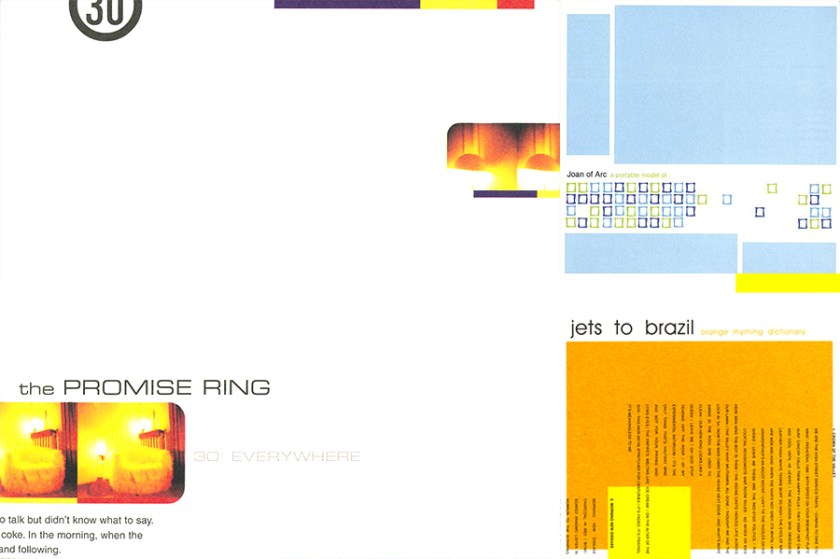
Truthfully, it didn’t matter much to me where I got started. I knew what to expect: me being relatively anti-social, listening to music, going to shows and learning design. Maybe, MAYBE, I’d make a couple friends through our mutual love of music, which is exactly how I found out about The Promise Ring. Someone told me they were fond of 30• Everywhere, and before I heard a single note, the album art reeled me in. It used color sparingly yet deliberately. It had WHITE SPACE on the cover. Clearly it was holding something back and I needed to know what it was, so I bought it.

On the first few listens, my focal points were “Everywhere in Denver” and “Red Paint.” I’d spent prior years predominantly listening to punk and uptempo indie, so the subtlety of something like “A Picture Postcard” was initially lost on me. Ever determined, I kept at it and over time the nuances of each song captured and held my attention.

Part of what kept me going back was the artwork. I was determined to make sense of something that looked so refined and beautiful. It sounds like I’m being overly dramatic, but I was at a fork in the road. Old self—high school student and stubborn malcontent—was part of this scene:

before.jpg

New self—aspiring to be a graphic designer with a good eye—wanted to be in this scene:

jg3.jpg

So I obsessively listened to 30• Everywhere followed closely by Nothing Feels Good and explored albums on different labels with similar aesthetics (and therefore, in my mind, a related sound).

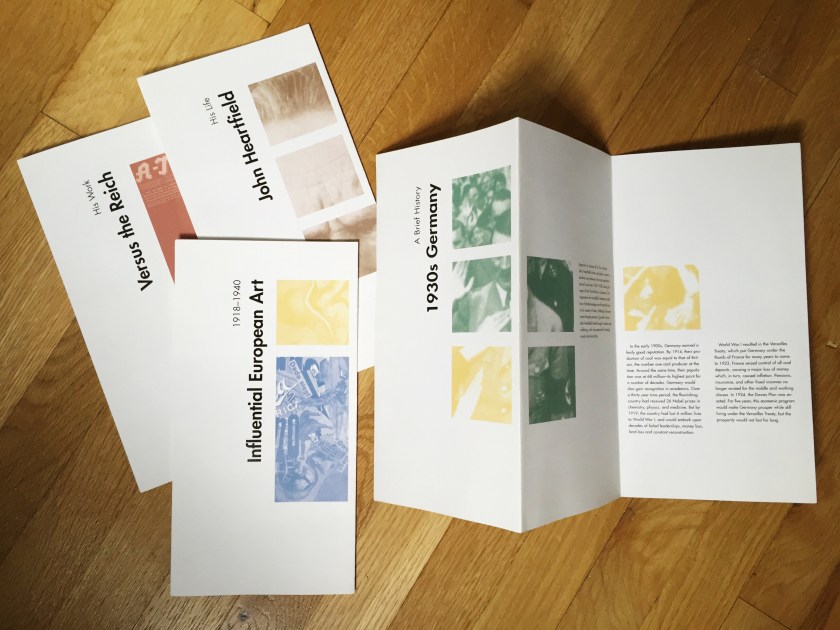
It was like passing through a door I never knew existed; a turning point for which your design work and music were a critical catalyst. This was where I fit in, if not immediately than at least I finally knew where I wanted to be and with whom. I felt compelled to take my education to the next level and transferred to RISD with the help of a scholarship, where I used your style as inspiration for one of my first projects:

IMG_0727.JPG
Note the use of geometry, white space and sideways text blocks.

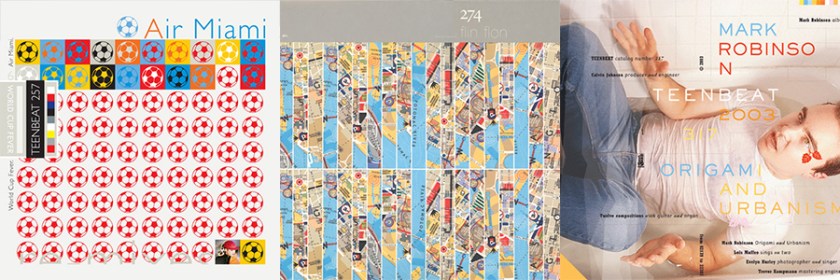
With broader knowledge of the music and design industries, this was not unlike the work of Peter Saville for Factory or Mark Robinson for Teen-Beat.

marc-robinson.jpg
Marc Robinson’s work above. Is there a need to show Saville’s? Most are at least somewhat familiar with it (for New Order in particular, or the ubiquitous Joy Division cover ripped off by Disney).

You too spearheaded the look and feel for a small music genre that touched fans on a very personal level. Whether they realized it or not, your aesthetics contributed greatly to the overall concept of their favorite music.

Thank you for inspiring me aurally and visually. My trajectory would have undoubtedly been different (and likely less interesting) without you.

Hugs,
Christine

RECOMMENDED LISTENING

Everywhere In Denver

Between Pacific Coasts

A Picture Postcard

Dear UK-ers/Mike Skinner/U.S. Music Fans (who may, or may not, be prepared for the imminent British Rap Invasion),

Sometime in the early 2000’s I got really into The Streets. If you’re reading this from the UK or Europe you’re probably nodding your head right now, “Yeah, yeah, The Streets…that bloke Mike Skinner.” But, if you’re reading this in the U.S., you may be already bored. You may not have heard of The Streets. I don’t say this to be elitist (but you can accuse me of that if you feel so inclined). I say this because there was no one else that I personally knew here in the U.S. who was taking a ride on the UK garage train at that time (Streets message board folk-you don’t count-you existed only online).

Based off of internet researching I did between 2000 something and 2007 I gathered that Mike Skinner was a big deal in the UK. Top of the Pops performing, BRIT Awards winning, Reading festival performing, beloved by NME big. Side note: I miss Top of the Pops (loved that show). I knew nothing of garage music, UK or otherwise. Consequently, The Streets sounded extremely fresh to me, totally new and unfamiliar in the best of ways. While I’ve always liked to think I have/had broad musical tastes the truth is I like a lot of rock n’ roll. Guitars, drums, G-Em-C-D chord progressions, verses and choruses….that whole bit. Original Pirate Material (“OPM”) was like the key to an entirely new land of music that I never even knew existed.

That’s not the only reason I got into The Streets. There were other factors. For one thing, a young Mike Skinner is easy on the eyes. He had/has that classically British droopy eye thing going for him. Paul McCartney had/has it too. I’m pretty sure it is uniquely British. Is there a name for it? Dreamy bloke disease? Geezer syndrome? It’s possible that you people in the UK take it for granted. You may not even realize it is a thing. Let me be the first to tell you that it is most definitely a thing.

But, Mike Skinner’s droopy eyes aside, OPM is really a most amazing album. Bias disclosed: I’m a real sucker for musicians who hole up alone, creating albums that have input from others but seem to mostly develop out of their own isolation. Per Wikipedia, “The recording of Original Pirate Material lasted over a year, with Skinner recording the bulk of the album in the room he was renting in a house in Brixton in south London. The instrumental tracks were created on an IBM ThinkPad, while Skinner used an emptied out wardrobe as a vocal booth, using duvets and mattresses to reduce echo.” An emptied out wardrobe serving as a vocal booth!?!?!?! Yes, please, always! Mike Skinner if you ever offer a recording class that teaches the intricacies of using wardrobes, duvets, and mattresses, I will be the first to register.

If you pretend that “Sharp Darts” and “Who Got the Funk” were tracks that somehow accidentally slipped onto the album, the rest of OPM is flawless. All of it clever, none of it boring despite it’s a day in the life focus, and most importantly (at least to a non-UK-er) so very very British. Per this article, Mike Skinner wasn’t very optimistic about Americans accessing his music. Let this letter stand as a counter point to that idea. You don’t have to be British to be obsessed with The Streets.

Bias disclosure number 2: I have always been obsessed with “British things.” Case in point; fell in love with The Beatles beginning in 2nd grade, watched the cartoon Danger Mouse religiously as a child, got into The Young Ones as a teen, and then—the final straw— lived in London for a semester during college. It’s true. Most certainly that study abroad experience is what built the bridge between my American mind and my receptivity for The Streets. When I first discovered it around 2004 or so, OPM served as some type of nostalgia for me as not that long ago I had lived in Kensington, just a short walk from the Baron’s Court tube stop. It was in 2000, the doomsday year when everyone thought society would come crashing to the ground because of the Y2K problem a.k.a. the Millennium Bug.

Ah, but Millennium Bugs are overrated!

The winter/spring of 2000 was glorious in London!

For those few short months it was all visiting Peter Pan statues, exploring night clubs, picking up our weekly stipends and spending them on the dark chocolate covered Hob Nobs and/or buying Crunchie bars from the vending machines in the tube stations, Pimm’s cups, buying platform boots in Covent Garden, eating our first knickerbocker glory ice cream sundaes, seeing Hefner live at a University, learning about buskers, getting used to brusquely being told “keep right” by locals, enjoying the sights and smells at Brighton Beach, seeing Belinda Carlisle lip synch at a frequently visited gay club, dancing wildly at this club in platform boots bought in Covent Garden, traveling to Kings Cross to see an all-girl punk band called Vyvyan, briefly co-hosting a show on the local University’s radio station with my “flat mate,” laughing with this flat mate about how it always seemed that the “bloke” who assisted in setting up for the show seemed to regularly leave a silent but deadly fart in his wake before leaving the booth, and finally Alice Deejay. Lots and lots of Alice Deejay as far as the ear could hear. You couldn’t escape this song in London in the year 2000. It would hunt you down and force you to love it. And, I did.

But, hold it down; it seems my head’s getting blurred. My experience in London was certainly that of an outsider. I cannot lay claim to truly understanding the culture. I do not use the phrase “go on” in my day to day life (but oh how I would like to!). I am used to drinking lemonade that is not carbonated. Oy is not part of my vocabulary. And yet, still, The Streets made sense to me because OPM was like an audio portal capable of transporting me right back to that gloriously grey and moderately temperate place that I had enjoyed so fully despite the fears that pervaded regarding the beginning of the millennium.

I saw The Streets perform in 2006 at the Intonation Music Festival in Chicago. I was so into them at that time (yes, my obsession lasted years) that I flew to Chicago, went to the festival, and then flew out of Chicago the following day. Lady Sovereign was an opening act and I was so sure that UK rap was going to break through into mainstream American music. Did it? Does Lilly Allen count? Kate Nash? Nope. I think I’m just grasping at straws here.

OPM, A Grand Don’t Come For Free, The Hardest Way to Make an Easy Living – these albums changed my perspective on music. They broadened it. Mike Skinner had a radio show on the BBC where he would play, and talk about, music he liked. I listened in (thank you internet) and was exposed to Reggaeton. Again, my musical tastes grew. Here’s an oldie but goodie from that genre/time.

Music is amazing in this way isn’t it? Mike Skinner openly shared that he was exposed to “American rap” and that this music was what inspired him to create OPM. I got into OPM, despite up until then being a pretty diehard rock music fan, which then led me into other genres of music like Reggaeton (which is rap, yes? No? Would you like to write on that topic for this very blog?). The U.S. and UK have this lovely little relationship connected to music don’t they? UK people appreciate the music and artists that we either ignore or take for granted (blues, Jimi Hendrix, too many artists to list). Then they make their own version of it and sell it back to us (The Beatles, The Stones, pretty much all of the British Invasion, Led Zeppelin, Mike Skinner). We eat it up. We can’t get enough. Because after all, they’ve got droopy brown eyes and use terms like “chuffed.” What’s not to like really?

Thank you Mr. Skinner for your witty lyrics, clever rhymes, and (former) bare bones recording techniques. I miss your music. A British Rap Invasion awaits. I’m certain of this.

Sincerely,
April

Addendum: While writing this letter I revisited A Grand Don’t Come For Free. That album will make you fall in love with Mike Skinner/The Streets, guaranteed. If you haven’t listened to it (ever) (recently), please make it a priority. You won’t regret it (he rhymes naught with out and makes it work).

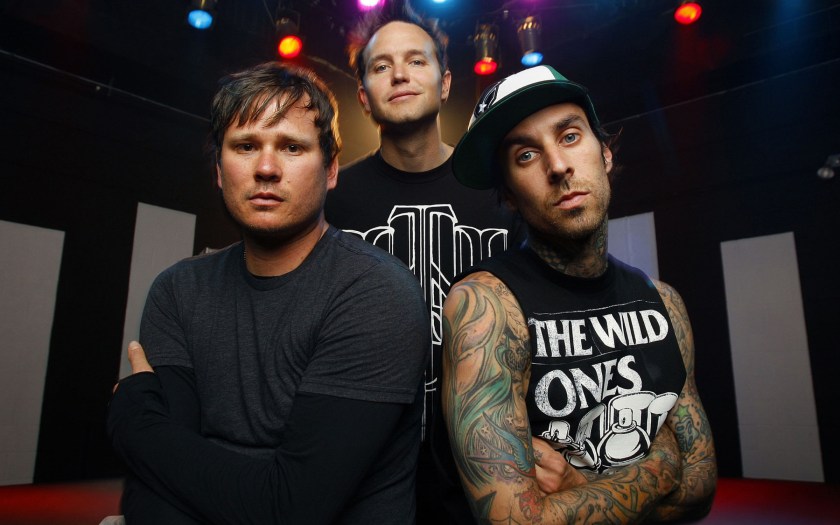
Tom, Mark and Travis, The Real Blink-182:

Guess what? I LOVE your music. I was 14 years old when I first heard Dude Ranch. Wow! I felt indestructible when I listened to that album. The song “Dammit” hit the nail on the head. The angst, profanity and humor that made up all the songs continued to do so for years to come. Thanks to you guys, it’s the kind of music that I learned to love. My skateboarding years would not have been the same without you. 

Next up was Enema Of The State. I was so happy to see you guys getting the recognition you deserved, and didn’t even know what you looked like until I saw the video for “Adam’s Song.” You really started to show your true talent when you wrote that song. You could have fun, act childish, and still write really good, popular songs about the sad parts of life. Impressive! That was just the beginning for you guys.

Take Off Your Pants And Jacket!!! What the hell?!?! Did you guys know that I was going in to my senior year of high school and write it specifically for me? Seriously, I can’t thank you enough for that brilliant mixture of songs. I still listen to “Reckless Abandon” to this day and feel like I’m 18 again. “Stay Together for the Kids” was the start of my addiction to Tom’s voice and unique style of singing. “Shut Up” was extremely vulgar, but I love the song and the fact that you guys aren’t afraid to piss people off. 

How about the self-titled album—you know, the one that everyone was pissed off about because you actually changed the way you sound? Typical for that to upset people. You didn’t even completely change your sound—it was only slightly changed, for the better. Seriously, who didn’t like “I Miss You”? It was so catchy and dark. Love! Love! Love! that song. Who would’ve thought that Robert Smith would sing on one of your songs? What a legend! You guys gained even more of my respect by including a short, impressive instrumental song on the album. I still listen to the whole album without skipping any songs (which means a lot to me). 

I had to wait eight more years for another album. I waited patiently. I knew you were having issues, but still had all your other albums to fall back on. I was/am a HUGE fan of Neighborhoods. I’m glad I waited and didn’t give up on you guys. “Ghost on the Dance Floor” is like a grand finale at the beginning of an album. “Wishing Well,” “Snake Charmer” and “Kaleidoscope” take me back to my early teens—in a good way—and make me smile ear-to-ear. Bravo!

I don’t know enough about California yet. My wife bought it for me a couple weeks ago and I haven’t had the chance to listen to it. I’m sure I’ll like it. I’ve enjoyed all the music you guys put out, even if there are certain pieces missing. +44 was good, I had a huge crush on Boxcar Racer and Angels & Airwaves is my shit!

I wear Hurley clothing because you got me in to it, I started getting tattoos because you have them, AND I stood out in the pouring rain and risked my health to see you perform live. If I’m not your biggest fan, then I don’t know who is.

blink-182-2880x1800-wallpaper-7506.jpg
Tom’s gray t-shirt is probably Hurley

Love you guys,
Gregory

I say “The Real Blink-182” because how dare you guys try to go on without Tom DeLonge. However, I’m not going to waste your time with bitching and moaning.

RECOMMENDED LISTENING

Dammit

Stay Together for the Kids

After Midnight

Dearest music of Kathleen Hanna and friends,

Outside my older brother’s door, in between sounds of Skinny Puppy and Cannibal Corpse there was a moment where I paused; I listened. Too afraid of teenage wrath that I may encounter, I stood attentively in the hallway. It was an earnest, fierce woman vocalist rocking out in a way I had not heard before; singing lyrics straight out of my feminist/activist/angry teenager heart! Later I discovered what I was hearing was a dubbed tape cassette copy of Kathleen Hanna’s first musical project Bikini Kill. The song was “Feels Blind” (still one of my faves).

I didn’t fully fall in love until later as I was incredibly uncomfortable with my own inner Riot Grrrl at the time. I truly have to dedicate this letter to my bro Duane. Without you dude, this letter would not exist!! I can say that for many of the tunes that I may write about in the future.

Bikini Kill made its way in and out of the soundtrack of my teenage years, following me thru years of punk rock shows in fire halls and crazy nights in dank and dark warehouse spots and church basements in Philly. Bikini Kill’s song “Rebel Girl” still gives me chills. When I landed in the state of Washington, birthplace of the Riot Grrrl movement, I would discover a whole world that Bikini Kill inspired.

It probably wasn’t until Kathleen created Le Tigre that my heart really exploded with resonance. My ears were kissed with this lovely sound of wild women making history (a collection of Zine writers, film makers and talented musicians singing their truth and social activism) in many different forms. One memory stands out. It was 2004 in L.A., and after seeing David Bowie (my other love) at the Shine auditorium, my husband Khenu and I made our way to an electro clash night at some club named Blue. We entered the club, hungry for good tunes and high from our Bowie experience. We were greeted by Le Tigre’s song “Deceptacon” blaring on the speakers and wild, uninhibited dancing followed.  I was reminded how this group made me dance my arse off as well as feeling like when I’m dancing to their music I’m in solidarity with other strong feminine voices.

Jump ahead to exactly one year later in San Francisco and I was blessed with the experience of dancing my arse off once again to Le Tigre and this time, right next to stage where Kathleen Hanna herself stood opening up for Beck! It was a perfectly odd pairing of a concert and the whole night was super rad. I’m pretty sure I pulled a muscle that night I was dancing so hard. I felt like a Le Tigre, Riot Grrrl, I’m-In-love-with-Kathleen-Hanna cheerleader and was unabashed in sharing my love for them that night. The crowd seemed inpatient for Beck to play so my husband Khenu and I really had to represent our love! So there wasn’t the electro mosh pit that I had envisioned yet it definitely goes on my list of top-five concerts.

When the documentary The Punk Singer came out, I was even more inspired. I was impressed with how she was so vulnerable; sharing about her music and the inspiration being from a troubled childhood and trauma that unfortunately many young girls and women go through. The fact that she sings about it and then makes a movie where she is so straight up about the horrible struggle with her illness (she has Lyme disease) and her hiatus from music is really brave. It doesn’t hurt that her hubby Adam Horovitz makes some appearances (yay Beastie Boys!).

Kathleen’s latest Bust magazine interview continued her truth telling. She shared how working on her Julie Ruin project helped her establish an identity outside of her illness (go music therapy!). Right now the pearly colored vinyl of Hit Reset is sitting atop my record player.

Soon after buying the album, I drove into San Fran to meet with a dear friend that I haven’t seen for years. I was about to bring her the Bust magazine article to give her in hopes that the article could add to her courage and strength to continue to fight her disease. This friend has also struggled with the symptoms of Lyme disease and has been through hell and back. As I brought this up to her she smiled with that smile of recognition of a synchronicity. She had been feeling ill for a long time, and didn’t know for sure that she had Lyme until she watched The Punk Singer! Since Kathleen was so authentic about her illness, my friend recognized that she had the same symptoms and it encouraged her to get tested! One example of how Kathleen, being brave in sharing her unedited truth no matter how messy, touched a soul.

Using the words of the same dear friend, “I plan to marinate in this latest Julie Ruin album” until we go and see her perform at the Fillmore in San Francisco in October! I feel so grateful to be able to witness Kathleen’s music again and to do so along side a fellow strong female warrior!

In closing, being an expressive arts therapist I have been and always will be magnetized to people that sing from their gut and from wounded places in their heart and bear their truth to all of us struggling humans. I aspire to have the same outlet and fearlessness as I continue to combat my own personal illness. Listening to the music now for me is helping me to reclaim my body, continue to fight for the right to have presence in this society as a woman, own my strong feelings and creative voice.

Kathleen, you are my Queen! Thank you for sharing yourself – even the darkest parts. In doing so you have shown light into the dark places of me and in many.

With love and admiration,
Heather

“Singing is my life, and I have to do it, or I’m going to go totally bananas.”
Kathleen Hanna